Misereor
Close search
Search for:
    Top results:
      Search in:

      Editor's recommendations:

      Publications

      Misereor produces a range of publications on its focal topics each year. Here you will find these documents for your information and use.

      Latin American Statement for Climate Justice and the Right to the City

      Latin American Statement for Climate Justice and the Right to the City

      In the context of the global negotiations –the 30th Conference of the Parties (COP30), the 13th

      In the context of the global negotiations –the 30th Conference of the Parties (COP30), the 13th World Urban Forum (WUF13) and other spaces– social movements, organizations, networks and local actors committed to habitat, housing and climate justice, raise their voices. Faced with a global crisis that is exacerbating historical inequalities, they reaffirm their capacity to organize, cooperate and self-manage, and demand effective, direct and urgent support with which to sustain and expand these responses.

      The document is open for further signatures.

      Download

      Soil Carbon Credits: Another Wave of Land Alienation in Northern Tanzania?

      Soil Carbon Credits: Another Wave of Land Alienation in Northern Tanzania?

      A research report by the Maasai International Solidarity Alliance (MISA)

      The Maasai International

      A research report by the Maasai International Solidarity Alliance (MISA)

      The Maasai International Solidarity Alliance (MISA) is an international alliance standing in solidarity with the Maasai of Northern Tanzania. We bring together international faith-based organisations, human rights organisations, international aid and development  organisations, as well as grassroots organisations, individual activists, researchers and lawyers representing the Maasai in several land cases. Our alliance includes, among others, the Africa Europe Faith Justice Network (AEFJN), Agrecol Association for AgriCulture & Ecology, Coalition of European Lobbies for Eastern African Pastoralism (CELEP), Center for Agroecology, Water and Resilience (CAWR) at Coventry University (UK), CIDSE - International family of Catholic social justice organisations (International), Indigenous Movement for Peace Advancement and Conflict Transformation (IMPACT), FIAN International, FINAL GOVERNANCE, KOO (Koordinierungsstelle der Österreichischen Bischofskonferenz - Coordinating Office of the Austrian Bishops’ Conference), Gesellschaft für bedrohte Völker (Society for Threatened Peoples), IDINGO - Integrated Development Initiatives in Ngorongoro, Misereor, PALISEP, PINGO’s Forum (Pastoralists Indigenous Non-Governmental Organisations), PWC (Pastoral Women’s Council), TEST (Traditional Ecosystems Survival Tanzania), UCRT (Ujamaa Community Resource Team) and Welthaus Graz. Our main objective is to put an end to the human rights violations facing the Maasai of Northern Tanzania.

      Download

      Freedom and rights of civil society under threat in Peru

      Freedom and rights of civil society under threat in Peru

      CIDSE, the international alliance of Catholic social justice organisations, is extremely concerned

      CIDSE, the international alliance of Catholic social justice organisations, is extremely concerned about the approval of legislative measures in Peru that jeopardise the support for the poorest and most vulnerable peoples and populations and undermine access to justice in cases of violations of human rights and collective rights.

      Download

      The Global Food Poverty Gap

      The Global Food Poverty Gap

      Publication

      No access! Why our global food system puts the poor at a disadvantage. And how we can

      Publication

      No access! Why our global food system puts the poor at a disadvantage. And how we can create good markets for good food.

      The “Global Food Poverty Gap” study shows how much income people lack in order to be able to afford a balanced diet. 3.1 Billion people cannot afford a healthy diet in 2022 and the global gap amounts to USD 2.59 Billion. However, this corresponds to just 1.86 percent of the global gross domestic product. The study shows how the poverty gap developed over time and how it differs among countries.

      Better markets for food are one way to address the issue. Examples from Brazil, India, and Uganda present the different barriers people face, what civil society organizations are doing to improve the situation, and how better policies could contribute to the progressive realization of the right to adequate food and nutrition.  


      Download
      With camelids into a sustainable future. Learning from pastoralist communities.

      With camelids into a sustainable future. Learning from pastoralist communities.

      Publication

      The importance of camelid herders for the conservation of our world's rangelands is

      Publication

      The importance of camelid herders for the conservation of our world's rangelands is increasingly recognized internationally. To mark the International Year of Camelids (IYC), this thematic dossier introduces camelid pastoralists, how they sustainably manage rangelands in the Andean highlands, East Africa and Mongolia, and why the global community should support camelid pastoralism for a resilient future of our planet.

      • Publisher: Misereor, League for Pastoral Peoples, DITSL
      • Pages: 20 
      • Responsible in terms of the law: Sabine Dorlöchter-Sulser, Rural Development Specialist at Misereor (sabine.dorloechter-sulser@misereor.de)
      Download
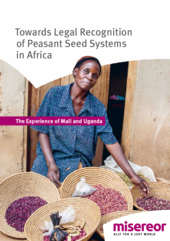
      Towards Legal Recognition of Peasant Seed Systems in Africa

      Towards Legal Recognition of Peasant Seed Systems in Africa

      Publication

      This study aims at giving fresh impetus to the debate in a threefold manner: firstly, it

      Publication

      This study aims at giving fresh impetus to the debate in a threefold manner: firstly, it provides an overview of the legal  framework conditions with regard to PSS at the international level. Secondly, it analyses national legislation of countries (India, Brazil, Ecuador, Italy and Ethiopia) which have attempted to legally recognise peasant varieties or PSS. Thirdly, it presents two examples of countries (Mali and Uganda) where civil society actors advocate for the recognition of PSS. 

      Download

      Global Sovereign Debt Monitor 2024

      Global Sovereign Debt Monitor 2024

      Report

      Compared to the years during the COVID-19 crisis, in some countries of the Global South the

      Report

      Compared to the years during the COVID-19 crisis, in some countries of the Global South the debt situation has slightly eased. For most countries there, however, the debt situation remains tense. In 130 of the 152 countries surveyed in the Global South, the debt situation is at least slightly critical; in 24 of these countries, the situation is very critical. Overall, 55% of the countries surveyed are critically or very critically indebted – in contrast to only 37% before the COVID-19 pandemic. In 2024, countries in the Global South have to make more debt service payments to their external creditors than ever before. For 45 countries, more than 15% of government revenue flows into debt servicing.

      • Published: 15 April 2024
      • Editors: Misereor and erlassjahr.de
      Download
      Discussion Paper: Towards a socio-ecological transformation of the economy

      Discussion Paper: Towards a socio-ecological transformation of the economy

      Discussion paper

      The present study gives an overview of approaches, concepts and examples. However,

      Discussion paper

      The present study gives an overview of approaches, concepts and examples. However, since there are many approaches and concepts and even more practical  experiences, the study cannot be complete but can only pick some prominent examples and serve as a starting point for the platform project. Participants of the platform project will add many more approaches, concepts and examples from their practical work to this initial collection and enrich it with their expertise, views and experiences.

      Download

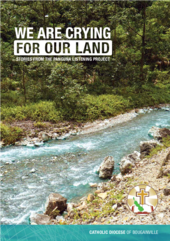
      We are crying for our land

      We are crying for our land

      Stories from the Panguna Listening Project

      From 1989 to 2001, Bougainville experienced a violent

      Stories from the Panguna Listening Project

      From 1989 to 2001, Bougainville experienced a violent conflict directly connected to the Panguna Mine. The Panguna Listening Project (PLP) is an initiative of the Catholic Diocese of Bougainville seeking to make the voices of the people heard in the Panguna mine affected areas.

      Download

      Report on Mental Health

      Report on Mental Health

      Publication

      This study explores the vulnerabilities, traumatization processes, and Mental Health and

      Publication

      This study explores the vulnerabilities, traumatization processes, and Mental Health and Psychosocial Support (MHPSS) interventions in the selected
      conflict-affected regions of Amhara, Oromiya, and Tigray, with a particular focus on the role of Church-based organisations. Using qualitative and participatory methods, the research highlights the need for scaling up MHPSS efforts, emphasizing best practices and locally-led initiatives, and culminates in recommendations for enhancing MHPSS in these regions.

      • Publisher: This qualitative study is the result of a participatory and collaborative effort by three German-based organisations: Brot für die Welt (Bread for the World), Caritas Germany and Misereor with their partner organisations (in alphabetical order): Daughters of Charity in Mekelle, Diocese of Adigrat, Ethiopian Catholic Secretariate, Ethiopian Evangelical Church Mekane Yesus – Development and Social Service Commission (EECMY-DASSC), Ethiopian Orthodox Tewahedo Church – Development and Inter-Church Aid Commission (EOTC-DICAC), St Mary’s College Wukro; with support from Tium Debessay (Don Bosco Salesians).
      • Publication date: August 2024
      • Number of pages: 75


      Download

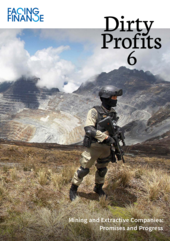
      Dirty Profits 6 - Mining and Extractive Companies: promises and progress

      Dirty Profits 6 - Mining and Extractive Companies: promises and progress

      Publication

      Dirty Profits 6 report released by Facing Finance highlights the investments of ten

      Publication

      Dirty Profits 6 report released by Facing Finance highlights the investments of ten European banks in ten transnational extractive companies like for example Glencore, Vale, Rio Tinto and others, variously which continually violate human rights and the environment. Violations cover contamination of land, water and air; silencing community activists using violence, threats and intimidation; labour violations and forced labour; and failure to provide the remedy communities deserve.  The Dirty Profits 6 report shows that the ten selected European banks alone provided capital of over €100 billion to these 10 extractive companies between 2010 and 2017. Most banks, particularly those that made the most capital available, are not taking strong enough action to ensure that mining and extractive companies respect human rights and environmental concerns. The authors of the report expect banks to take responsibility for human rights and environmental concerns in their decision making, e.g. by improving transparency and making public all relevant information related to engagement and by taking a proactive approach to identifying non-compliant companies.

      Download

      My Life - Starting Now

      My Life - Starting Now

      Knowledge and skills for young adolescentes, by Lucy Y. Steinitz with Eunice Karanja Kamaara

      Download
      I support Misereor
      • Development support provided since 1958
      • Through more than 100,000 Projects
      • In Africa, Asia, Oceania and Latin America
      Donate by bank transfer: IBAN DE75 3706 0193 0000 1010 10 - BIC: GENODED1PAX - Pax-Bank für Kirche und Caritas eG