
Global Europe, Global Responsibility
Delivering Development and Climate Impact in Africa
Here you'll find publications on:
In the context of the global negotiations –the 30th Conference of the Parties (COP30), the 13th…
In the context of the global negotiations –the 30th Conference of the Parties (COP30), the 13th World Urban Forum (WUF13) and other spaces– social movements, organizations, networks and local actors committed to habitat, housing and climate justice, raise their voices. Faced with a global crisis that is exacerbating historical inequalities, they reaffirm their capacity to organize, cooperate and self-manage, and demand effective, direct and urgent support with which to sustain and expand these responses.
The document is open for further signatures.
Policy brief
Latin American cities critically concentrate climate impacts, putting fundamental…
Policy brief
Latin American cities critically concentrate climate impacts, putting fundamental rights at risk such
as adequate housing, basic services, the public space and life itself. More than 80% of the region’s population live in urban environments marked by inequality, exclusion, sectoral policies
and institutional fragmentation. Despite often being invisible, its poorest communities are, however, leading collective and innovative actions and solutions that combine adaptation, mitigation and social justice.
Toward Stronger Alignment between APRA, Mission 300, and AGII
Policy Brief: Germany should support…
Toward Stronger Alignment between APRA, Mission 300, and AGII
Policy Brief: Germany should support Africa’s green transformation through coordinated finance, tech transfer, and inclusive governance – offering strategic recommendations for climate action, equity, and shared resilience.
A research report by the Maasai International Solidarity Alliance (MISA)
The Maasai International…
A research report by the Maasai International Solidarity Alliance (MISA)
The Maasai International Solidarity Alliance (MISA) is an international alliance standing in solidarity with the Maasai of Northern Tanzania. We bring together international faith-based organisations, human rights organisations, international aid and development organisations, as well as grassroots organisations, individual activists, researchers and lawyers representing the Maasai in several land cases. Our alliance includes, among others, the Africa Europe Faith Justice Network (AEFJN), Agrecol Association for AgriCulture & Ecology, Coalition of European Lobbies for Eastern African Pastoralism (CELEP), Center for Agroecology, Water and Resilience (CAWR) at Coventry University (UK), CIDSE - International family of Catholic social justice organisations (International), Indigenous Movement for Peace Advancement and Conflict Transformation (IMPACT), FIAN International, FINAL GOVERNANCE, KOO (Koordinierungsstelle der Österreichischen Bischofskonferenz - Coordinating Office of the Austrian Bishops’ Conference), Gesellschaft für bedrohte Völker (Society for Threatened Peoples), IDINGO - Integrated Development Initiatives in Ngorongoro, Misereor, PALISEP, PINGO’s Forum (Pastoralists Indigenous Non-Governmental Organisations), PWC (Pastoral Women’s Council), TEST (Traditional Ecosystems Survival Tanzania), UCRT (Ujamaa Community Resource Team) and Welthaus Graz. Our main objective is to put an end to the human rights violations facing the Maasai of Northern Tanzania.
Publication
Despite adaptation efforts, climate-induced disasters are increasingly affecting…
Publication
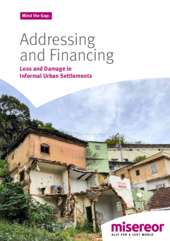
Despite adaptation efforts, climate-induced disasters are increasingly affecting vulnerable urban communities. Using case studies from Sao Paulo (Brazil), Nairobi (Kenya) and Jakarta (Indonesia), the research summary commissioned by Misereor and conducted by UNU-EHS and MCII analyses how vulnerability, exposure and climate-related hazards cause economic and non-economic losses and damages in urban informal settlements. It identifies strategies to avert, minimise and address losses and damages, and how financing mechanisms should be designed to ensure adequate support for the most climate-vulnerable urban communities.
Briefing Paper
Given the particular vulnerability of informal urban settlements, it is of utmost…
Briefing Paper
Given the particular vulnerability of informal urban settlements, it is of utmost importance to ensure the speed, eligibility, adequacy and accessibility of damage financing. Innovative approaches that take into account the specific characteristics and needs of informal settlements must be considered and implemented.
Publication
Climate change is already resulting in more intense and frequent disaster events. These…
Publication
Climate change is already resulting in more intense and frequent disaster events. These events are either so-called sudden onset events that occur within hours or days, such as flash floods, heavy rainfalls or storms or slowonset processes such as drought and rainfall variability that are not visually striking and have an immediate disruptive effect. Their gradual progression can obscure immediate impacts, which makes it difficult to measure or even perceive changes (Singh et al. 2021). Both types of events can result in disastrous consequences for the affected people, their belongings, and the environment.
Publication
Fossil fuel extraction fans the flames of the climate crisis and hinders development in…
Publication
Fossil fuel extraction fans the flames of the climate crisis and hinders development in African countries
This dossier emphasises a forward-looking perspective through African voices, advocating for an African future where development is decoupled from fossil fuels, where sustainable energy drives prosperity and Africa’s well-being, and where the continent takes its rightful place in the global dialogue on climate, energy and development.
Publication
The expansion of fossil fuels in Africa has serious social and economic consequences…
Publication
The expansion of fossil fuels in Africa has serious social and economic consequences that hinder development in many countries. The report “Fossils Implicated.” shows how renewable energies can promote sustainable development and at the same time support global goals such as the 2030 Agenda and the Paris Climate Agreement.
Publication
In the fight against climate change and the destruction of the environment, the idea of…
Publication
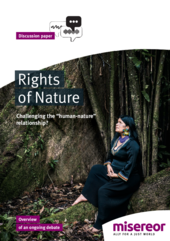
In the fight against climate change and the destruction of the environment, the idea of the rights of nature is increasingly gaining prominence, especially in countries of the so-called Global South. The Misereor discussion paper presents fundamental aspects and developments of the approach and places it in the context of the socio-ecological transformation.
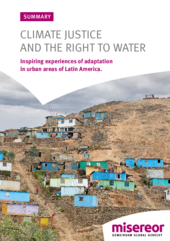
Inspiring experiences of adaptation in urban areas of Latin America.
Publication
The publication aims to show how the right to adequate housing and related rights are…
Publication
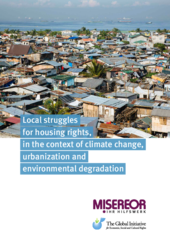
The publication aims to show how the right to adequate housing and related rights are threatened by climate change, increasing urbanization and environmental degradation, by highlighting ground-level experiences from Africa, Asia and Latin America. It aims to encourage an integrated approach to policy-making and to present examples of community-led tools and solutions from five countries: Cameroon, El Salvador, Nigeria, Peru and the Philippines. The report concludes with recommendations to national governments, local governments and the UN human rights mechanisms.
The full report is available in English. You can find the summary of the report in German, Spanish and French.
The publication aims to show how the right to adequate housing and related rights are threatened by…
The publication aims to show how the right to adequate housing and related rights are threatened by climate change, increasing urbanization and environmental degradation, by highlighting ground-level experiences from Africa, Asia and Latin America. It aims to encourage an integrated approach to policy-making and to present examples of community-led tools and solutions from five countries: Cameroon, El Salvador, Nigeria, Peru and the Philippines.
The world population is growing. More and more people need housing and…
The world population is growing. More and more people need housing and infrastructure for a good life. New settlements and rappidly growing cities further increase this need. At present about 3.5 billion people live in cities. The United Nations predicts that by 2050 this figure will rise to about six billion. The informal settlements that currently house almost one billion people could thus acquire an additional one to two billion inhabitants. Cities in Asia and Africa are expected to experience the biggest increase.
The document can also be ordered by e-mail at:
Silvia.Cottin@misereor.de
Climate Mitigation and Justice in the energy sector. Five perspectives from Africa, Asia…
Climate Mitigation and Justice in the energy sector. Five perspectives from Africa, Asia and Latin America.
Misereor has started a dialogue process on sustainable energy, mitigation in the energy sector and energy justice with partners in 7 countries. Not only clean energy but fair and equal access to resources and energy has been a special focus. Read the key findings.
The document can also be ordered by e-mail at: Silvia.Cottin@misereor.de
European governments and the EU are handing out more than €112 billion each year to prop up…
European governments and the EU are handing out more than €112 billion each year to prop up the production and consumption of fossil fuels, despite a pledge to phase out harmful subsidies out by 2020.
A new report by the Overseas Development Institute and Climate Action Network (CAN) Europe, where Misereor is a member, has for the first time gathered detailed information on the support provided to fossil fuels such as oil, gas and coal from 11 European countries and the EU between 2014 and 2016. CAN Europe urges Governments to stop subsidizing fossil fuels and invest into climate friendly development.
Limiting global temperature rise as set out in the Paris Agreement can only be achieved…
Limiting global temperature rise as set out in the Paris Agreement can only be achieved – according to mainstream opinion – by technologies hopefully available in the future. This publication shows practical examples how we can realize a habitable world for all already today, instead of postponing the solutions to the climate crisis.
The encyclical Laudato Si’ – A Magna Carta of integral ecology as a reaction to…
The encyclical Laudato Si’ – A Magna Carta of integral ecology as a reaction to humanity’s self-destructive course. This background paper explores the potential relevance within a pluralistic society of the important encyclical Laudato Si’ issued by Pope Francis in June 2015.
Establishing Human Rights Principles in the Urban Agenda. Misereor Policy Paper on…
Establishing Human Rights Principles in the Urban Agenda. Misereor Policy Paper on the 3. UN Conference on Housing and Sustainable Urban Development (Habitat III).
This report summarises inputs and discussions of a conference organised in India in October…
This report summarises inputs and discussions of a conference organised in India in October 2009 by Misereor and Welthungerhilfe in partnership with South-Asian partner organisations. It includes the recommendations that were formulated and that highlight the need to recognise local people’s strategies in adapting to climate change.
Guiding Principles and Recommendation for climate policies in regards to agriculture.…
Guiding Principles and Recommendation for climate policies in regards to agriculture. CIDSE (2012).
Various “climatefriendly” agricultural solutions have already been proposed: they include…
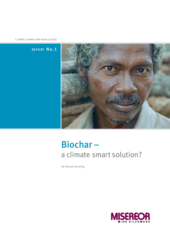
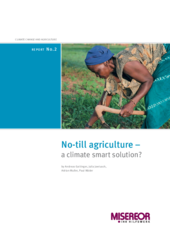
Various “climatefriendly” agricultural solutions have already been proposed: they include biochar and no-tillage agriculture. Against this background, Misereor uses this series of papers to examine whether these solutions actually lead to climate-friendly and equitable agriculture with a clear commitment to a pro-poor approach.
Climate change is one of the biggest challenges facing our globalized world today. The poor…
Climate change is one of the biggest challenges facing our globalized world today. The poor population in developing countries will be particularly affected by global warming, of which developed countries are the major drivers. Science clearly indicates that a global temperature rise of 2°C above pre-industrial levels may change the face of the world irreversibly. A range of
mitigation solutions is needed to avoid exceeding the 2°C limit. The need for truly sustainable and climate-friendly development is clear.
To attain the goal of limiting global warming to below 2°C in order to protect those living in…
To attain the goal of limiting global warming to below 2°C in order to protect those living in poverty from the severe impacts of climate change, sustainable and climate-friendly development in all economic sectors is essential. In the run-up to Rio+20, the Environment Programme (UNEP) has identified agriculture as a sector vital to the process of transformation from “brown” to “green” economies.
Enhancing food security in a sustainable way without putting the global climate at risk is one…
Enhancing food security in a sustainable way without putting the global climate at risk is one of the main global challenges. It is clear that support for farmers is urgently needed. Many argue that carbon markets are a good instrument for the mobilisation of fi nancial resources to ensure climate change mitigation in the agricultural sector while also alleviating poverty and fostering adaptation to the severe impacts of climate change. Misereor, based on its 50 years of experience in poverty alleviation, does not share these hopes...
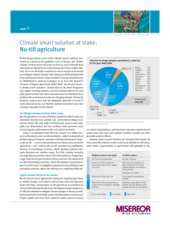
No-till agriculture is one of the ‘climate-smart’ solutions promoted as a panacea for problems…
No-till agriculture is one of the ‘climate-smart’ solutions promoted as a panacea for problems such as hunger and climate change. Several voices advocate no-till as a way to benefit from international climate finance and existing and future carbon markets. But is no-till really a solution to reduce hunger in the world and mitigate climate change? And should no-till farming benefit from existing and future carbon markets?
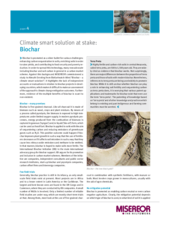
Biochar is promoted as a silver bullet for various challenges: enhancing carbon sequestration…
Biochar is promoted as a silver bullet for various challenges: enhancing carbon sequestration in soils, enriching soils in order to raise yields, and contributing to food security and poverty reduction. In order to spread this technology, many now advocate including biochar and soil carbon in general in a carbon market scheme.